Check out

Why I hate handwritten sermon notes
A bit tongue-in-cheek (I think), but some good points nevertheless.

20 Things Pastors Hear in Counseling
Timothy Reymond: “The following are 20 statements you’ll probably hear at least once or twice (or more) in your ministry.  I’d encourage you to think through how you’d respond, and more importantly, what specific passages of Scripture you might connect to each situation.”

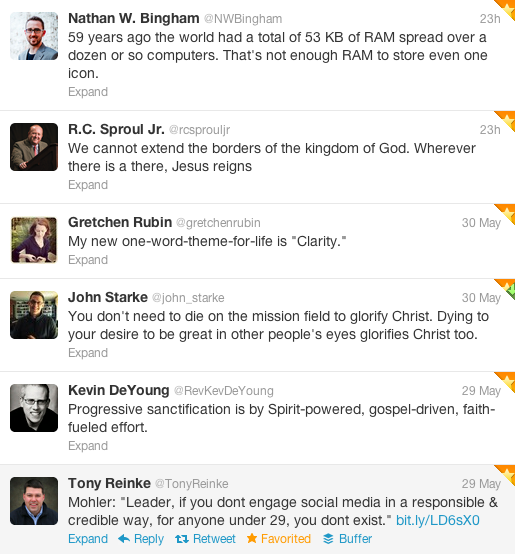
The Best Social Media Tip I Can Give You
When Nathan Bingham says this, I listen.

Ditch College for All
The debate continues.  Bit extreme but maybe that’s necessary to drag society to a more balanced position.

Dear Peter Thiel: Let’s fix college the right way
On the same subject, but more balanced, constructive, and innovative: “We can make the old-style college degree obsolete. We can do to traditional education what PayPal did to banks and do to college networks what Facebook did to friendships. Just as it happened to information, we can make education abundant and available to all. Isn’t that better than debating who should go to college?”

Scholarship as a way of life
James Smith calls us all to lifelong learning, whatever our calling: “To say that scholarship is a way of life is to emphasize that it is characterized by certain habits–of reflection, exploration, creativity, and collaboration.”


He just “stole” my book

How would you feel if you’d been working on a book for six months or so, researching, reading, writing some chapters, structuring others, gathering quotes, planning interviews, when you discover that someone else has beaten you to it! Happened to me last week.

There I was grazing through my blog subscriptions on Google Reader when I came as usual to The Blazing Center blog. There’s my book! Even my title!! Talk about blazing mad.

Who is this? Stephen Altrogge. How did he get inside my laptop? Has he been bugging my phone? All my work sucked away for an eBook! An eBook!! Not even a real book!!!

Launch date, May 29. Well, still time to sabotage this. But how? After a weekend of plotting came up with nothing, I was reduced to nervous hovering over the “Buy now with one click” button early yesterday.

Only 45 pages? How did he manage to compress all my work into 45 pages? He’s obviously butchered it to pieces.

But as I started to read, my temperature started falling and my blood pressure eased. Hmm, he didn’t copy too much after all. Actually he’s taken quite a different tack to me. It’s a brief gospel-centered romp through the biblical call to be creative. And it’s pretty good. In fact, don’t tell him, but it’s very good – good teaching, good application, great writing. And I love it most of all because it means I can get my work back out of the trash can. That’s surely worth an Amazon review.

My top ten takeaways from the book:

  1. Our Creator has equipped every single person with creative gifts and called us to be creative in the little corner of the creation He’s given to us.
  2. By being creative we show the world what God is like
  3. Creativity is not confined to artists but extends even to accountants [Not sure creative accountancy is a terribly good thing]
  4. As a Creator who loves creativity, God loves to see his creatures creating
  5. Fear (of failing, of not finishing, of looking stupid) is the great creativity killer
  6. Assurance of our acceptance in Christ makes us more creative, because His approval is enough.
  7. Don’t wait until you have a totally original idea or totally perfect idea
  8. Creativity is a muscle that gets stronger with use
  9. Creative work requires faithfulness, diligence, and persistence.
  10. Create for the glory of God and the good of others and you’ll be personally rewarded too.

You can read more about the book here.


Check out

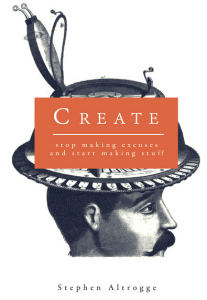
Create: Stop making excuses and start making stuff
New ebook on creativity from Stephen Altrogge. A short, lively, challenging, practical, and Gospel-centered call to discover and exercise our God-given creative gifts in our little corner of the creation, for the glory of our Creator and the good of our fellow-creatures. Buy on Amazon for $2.99 here.

How you can help Gospel eBooks
“We hope you’ve been enjoying all the free & discount e-books that we’ve been sharing daily. We enjoy doing this as a service to you. If you’ve been blessed by what we do we have a few non-monetary ways you can help us out. Social Media, search engines, blogging and websites are very important to us as the primary ways people find out about Gospel e-Books. Can you please take a few minutes to help us increase our footprint in these areas?”

“Oh, how I love your law!” Does that sound like a modern Christian?
R C Sproul: “We need to seek the law of God—to pant after it—to delight in it. Anything less is an offense against the Father, the Son, and the Holy Spirit.”

Fearfully and wonderfully made, Woefully and Tragically fallen
Thoughtful and thought-provoking article on the impact of physiology and sociology on human personality.

How Al Mohler uses Social Media
“Leader, if you don’t engage social media in a responsible & credible way, for anyone under 29, you don’t exist.”

William Still sermons online


4 Reasons to Remember your Creator in Middle Age

Although it’s young people that are specifically commanded to remember their Creator (Eccl. 12:1), it’s probably assumed that middle-aged people will have the sense to do the same. Surely by then we have accumulated enough experience to realize that remembering we have a Creator and that we are creatures is basic wisdom. How then do we respect and remember our Creator in busy, striving, stressed-out middle age?

1. Remember that we are complex creatures
The body is a complex mix of physical material and physical forces – electricity, chemistry, physics, biology, plumbing, gasses, pumps, siphons, lubrication, buttons, switches, receptors, etc.

Then there’s the soul, way more complex than the body and completely inaccessible to empirical research methods. Although we have some Biblical data to mine and research, yielding us some basics about the soul’s capacities and abilities, so much about the soul remains a mystery.

And then you put complex body and complex soul together and what do you get – multiple complexities!

The interconnectivity of human nature means that the health of the body affects the health of the soul and vice versa, and it’s not easy to figure out the contribution of each to our problems! One thing is for sure, we cannot neglect one realm and expect the other not to suffer the consequences.

2. Remember that we are limited creatures
Hopefully none of us think that we are unlimited. However most of us think we are less limited than we actually are. We vastly over-estimate our physical strength, emotional stamina, moral courage, spiritual maturity, volitional muscle, and conscience steel.

Underestimating our limitations and over-estimating our abilities can only have one outcome – weakness, fraying, and eventually breaking. Try it with anything – your car engine, a towrope, your computer, etc. Underestimate the limitations and over-estimate the abilities and you will eventually blow the engine, break the rope, and crash the computer.

We must find out our limits – physical, spiritual, emotional, moral – and work within them. And we must not impose our limits on others, despising those with lower limits or envying those with higher limits.

3. Remember that we are dependent creatures
Even before the fall, Adam and Eve were dependent upon their Creator. They leaned upon him for everything. That was their most basic human experience, and in a fallen world it’s even more necessary.

Many of us are theologically dependent but experientially independent. We depend on God with our lips but not with our lives. We say we lean upon Him for everything but He rarely feels our weight. If we don’t live as dependent creatures, we are not worshipping our Creator. By our independence, we are worshipping and serving the creature rather than the Creator.

4. Remember that we are fallen creatures
As part of the curse upon us for our first parent’s first sin, death entered the creation and even the greatest creature – humanity.

If you thought we were complex before, we are even more complex now. I enjoy fishing, and like all anglers, I “know” that the most complicated and sophisticated reels catch more fish. But, when they break down they make a much bigger mess than standard reels.

That’s why complex humanity is in a much worse state than any other creature. That’s why nature films focus on animals rather than humanity. Who wants to look at ugly human creatures in all their brokenness when you can see much more beauty in the animal kingdom!

But that’s not the end of the story. Remember, middle-agers, our Creator is in the business of re-creating. In salvation, He begins the process of making all things new, including His creatures. In fact, the Creator lived as a creature in the midst of His creation to save His creatures.

This post was first published at Ligonier Ministries blog. See also the previous post: 4 Reasons to Remember your Creator in your Youth.

Check out

Preparing your teen to thrive at College
Alex Chediak was recently interviewed on Focus on the Family about helping parents prepare their teens for the college environment so they may continue to mature spiritually, academically and socially away from home.  Part 1 and Part 2. And here’s a pdf of a parent/child college discussion guide.

Pastors pursuing a PhD
Great, great article here from Mark Jones.

What Americans think is right and wrong
If you can make sense of this, you get a PhD.

Today was meant to be my wedding day
Powerful testimony.

How do you know you’re ready for an agent
Some tough love for writers from Mary DeMuth.

Introducing the Psalms to a Hymn Singing Church
Nick Batzig outlines the challenges and some possible solutions as well.