Want a happy marriage? Marry someone poor and ugly!

Yes, that’s right, forget Prince Charming and look for an ugly sister. (How’s that for a mixed metaphor!)

Time reports the findings of a University of California study:

Lower-class” individuals—i.e., folks without much money or education—demonstrate more compassion and empathy than their wealthy counterparts, according to a series of psychological studies. In social scientist speak, “self-oriented behavior” is more likely to be exhibited by people with good educations, prestigious jobs, high incomes, and overall higher-ranking social status.

This follows hard on the heels of Edinburgh University research into the impact of beauty on ethics. It was published in the journal Economics and Human Biology and concludes “Pretty people are more selfish.” Time explains:

New research suggests that people with symmetrical facial features tend to be selfish and are less likely to cooperate with others. Facial symmetry is believed to have a large hand in how people perceive aesthetic beauty and physical attractiveness…

Attractive people are not only selfish by nature, but also more self-sufficient. They are less likely to ask for help, which kind of debunks that whole damsel-in-distress stereotype.

It all brings to mind the vivid imagery of gold jewels and pigs’ noses, doesn’t it (Proverbs 11:22).

Proverbs 11:22

I wonder what would the male equivalent of that proverb would be?

I hasten to add that my own wife blows this research out of the water!


Better to worship in the pew than the pulpit?

One of the benefits of having to sit in the pew more often than I was used to before my illness is not only to hear more good preaching but also to be more “involved” in the worship of God.

Like many preachers I’ve often found it difficult to get fully engaged in corporate worship. Partly it’s because of the sense of responsibility for leading the service; partly it’s the burden of having to preach shortly; but it’s also partly the “distance” from the congregation.

On a platform or in a pulpit you hear the general volume of the gathered voices (if the instruments are quiet enough!), but you don’t get to hear the subtle and beautiful pathos in individual voices.

I was reminded of this recently when a deep male voice started singing near my pew. I recognized it immediately and, knowing the person as I do, I was able to understand why he was singing these words with such passion and feeling in his voice. It so enhanced my own singing of that Psalm as I joined my voice and experience to his. It felt like I was singing in stereo.

Another time it was a female voice and, again, from what I know of her life and providence, I could tell what was going through her mind as she sang words very appropriate to her situation. Again I was able to worship God more meaningfully as I listened to the joyful trembling in her voice.

Probably neither of these people have any idea how much they ministered to me and thereby heightened my own worship. Maybe, hopefully, I’ve done the same for others at times.

Though I still miss pulpit-Sundays, my pew-Sundays have given me a new understanding and appreciation of two-dimensional, or bi-directional, worship. There’s the “singing and making melody in your heart to the Lord,” but there’s also the horizontal “addressing one another in psalms and hymns and spiritual songs” (Eph. 5:19-20).

And more of the latter results in more of the former.


A Beautiful Portrait of Paul

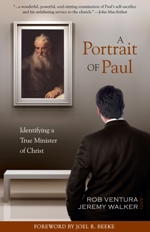
A Portrait of PaulI never knew there was so much truth in so few verses. Rob Ventura and Jeremy Walker have mined the depths of Colossians 1:24 – 2:5 and have brought out to the light of day 10 wonderful chapters that not only paint a captivating portrait of the Apostle Paul, but of every faithful Gospel minister.

As someone who is about to begin teaching a course on The Minister and his Ministry, I’m so glad to be able to commend a book like this to my students. Most books on pastoral ministry take a thematic or topical approach and proof text their points from all over Scripture. The strength of A Portrait of Paul is its exegetical foundation; while referring to other Scriptures, it concentrates on expounding eleven verses in Colossians.

This enables us to follow the Spirit-inspired train of thought, while also enjoying a fine example of how to minister God’s Word. And contrary to what you might expect from such an approach, the authors manage to paint a beautifully rounded picture of a Gospel Minister, as you can see from the chapter headings:

1. The Joy of Paul’s Ministry
2. The Focus of Paul’s Ministry
3. The Hardships of Paul’s Ministry
4. The Origin of Paul’s Ministry
5. The Essence of Paul’s Ministry
6. The Subject of Paul’s Ministry
7. The Goal of Paul’s Ministry
8. The Strength of Paul’s Ministry
9. The Conflict of Paul’s Ministry
10. The Warnings of Paul’s Ministry

There are many “How to” books on the Ministry – and this book also has numerous practical applications – but not many build a theology of ministry on such strong biblical foundations as this one. And is that not what’s needed today? With record numbers of men leaving the ministry, having tried all the “How-to’s,” is it not time we actually stopped and went back to the Scriptures with the simple question, “What is a minister of the Gospel to be?” For only then are we in a position to ask, “What is a Gospel minister to do?” That’s what this book does so well; and it does it with lively, pacey, and contemporary language.

Another strength of the book is that it is not just for pastors and students for the ministry, but it’s for all Christians. Each chapter has a section of application to fellow-pastors, but also one addressed to fellow-Christians. Ventura and Walker see the importance not just of ministers being able to identify themselves, but of Christians being able to identify ministers. How many Churches would be spared so much trouble if – before calling a minister, criticizing a minister, dismissing a minister, or leaving a minister – people actually knew from the Word of God what a true minister of the Gospel looked like!

There’s one danger with a book like this, the danger of idolizing Paul. I’m reminded of one minister’s wife who became so exasperated by her husband’s over-frequent references to the Apostle that she exclaimed at the dinner table, “Remember dear, it was Christ who saved me, not Paul!”  Ventura and Walker skillfully avoid this potential pitfall by continually taking us back to the Christ who not only painted the portrait of Paul but who perfectly modeled Gospel ministry in this world.

Buy A Portrait of Paul.

* Jeremy Walker blogs here.


Your own personalized Google

I’m sure most of you have searched Google for a particular subject (e.g. Worship), found five million results, and given up trying to find a worthwhile post after five or six pages.

Or maybe you’ve tried to refine your search with multiple combinations of pluses, minuses, quotation marks, etc, and narrowed your search down to…one million results. Hmmm.

And then there’s that article you remember reading last year on the subject, but what website was it on? And who wrote it?

Don’t you wish you had your own personalized Google, one that was tailored just to your interests, that would spare you so much of this frustration?

Well, you can. It takes a bit of work and perseverance, but the results are worth it. Welcome to Diigo. Strange name, but excellent idea.

I started using this simple bookmarking system a couple of years ago and although it’s taken 5-10 minutes every day to keep it organized and updated, I’ve saved myself so much time and hassle in the long term.

Basically I use Diigo to bookmark, highlight, and tag every useful article I read on the Internet. You can get a little Diigo plug-in for most browsers; a Diigo icon sits on your navigation bar and when you read anything good on the Internet, you simply click to bookmark it, highlight any particularly helpful text in the article, and tag it with relevant words.

Now, when I want to search for articles on “Worship,” I go to my Diigo homepage and enter my search there. That brings up any articles I’ve tagged with “Worship,” gives a brief description of the article, and even shows me any text I highlighted when I originally read it. Soooo much quicker! And if you stick at it over time, eventually you’ve built up your own personalized Google, a search engine that is tailored to your own special interests. A few other neat features are:

1. You can follow other people. If you follow me (davidprts is my Diigo user name) you can have the posts I bookmark every day sent to you in a daily update, or simply look at my Diigo homepage to see what I’ve been up to. So, say you have to do a talk on “a Christian view of Technology” you can head on over to my Diigo search bank and find articles that I’ve bookmarked “Technology” over the last few years. You’ll have to figure out which ones I agree with and which I don’t!

2. You can start groups. I have Diigo groups for some of my PRTS classes and invite the students to join. That means that when I see a post that’s relevant to, say, my Ministry class, I bookmark it for that group and the students’ learning experience is enhanced by seeing the kind of posts I think will be helpful for that particular subject. Diigo helps me keep teaching outside class hours!

3. You can annotate pages. You can attach “post-it” notes to webpages and read notes that others have posted there too. Or you can get students interacting about an article or blog post using this feature.

4. You can make bookmarks private. Obviously there are some things I want to bookmark that I’m not that keen for everyone to know about. For example, if I’m bookmarking sites with cribs, push-chairs, and diapers, well someone might think… (for the avoidance of doubt and gossip, that was an attempt at a joke).

5. You can mark articles “Read later.” Instead of seeing a good article, deciding to come back to it later, and forgetting where you read it, you can save articles for reading later, something best done in batches.

Criticism

My only complaint is that Diigo does not yet allow emailing of articles and posts. Evernote allows you to email from your iPhone or iPad with tags in the subject line and everything is filed away for you. With Diigo, if I’m reading my RSS feed on my iPad using Flipboard, I have to email good articles to Gmail, open them in my browser, then bookmark and tag. That’s a bit of a hassle (and I’m sure Diigo are working on this – please!), but it’s still worth it for the long-term benefit.

Subscribe For A Free Film From HeadHeartHand Media

When a student (yes, you Michael) eventually persuaded me to start blogging just under two years ago, I never expected it to become such a large and enjoyable part of my life and ministry. With such small expectations I looked for a blogging platform that would make it as easy as possible to post regularly with minimal hassle. With its email-to-blog feature, and its simple maintenance interface, Posterous was the obvious answer.

However, as the HeadHeartHand blog has developed and grown, the limitations of Posterous have become more obvious. Also, my Christian film company, HeadHeartHand Media has been growing in parallel over the past year.

I’ve therefore decided to change my blogging software to WordPress and to move it to a new shared site with HeadHeartHand Media.

The blog’s content will remain the same – a mixture of Ministry and Leadership subjects such as Preaching, Counseling, Old Testament, Technology, etc. The only changes you’ll be aware of will be improved presentation and a different location.

As many of you receive the “old” Posterous blog content via RSS or email, I want to “encourage” you to make the change to the new blog by giving a free digital download of CrossReference: The Angel of the Lord to all subscribers to the new blog.

So here’s the deal: anyone who subscribes to the new HeadHeartHand blog by RSS or email, will receive a download code embedded in their RSS feed or email from Monday to Wednesday next week. The only condition is one download per subscription.

So head over to the social media icons on the right of my photo, subscribe by RSS or email, and get your free film next week!

I look forward to serving you here and enjoying your valued contributions via the Comments.

And before I go, let me give a big thank you to Nathan Bingham and Cameron Morgan whose technical and design skills made all this possible. Thanks so much, guys; you’re a great team and a joy to work with.

Nathan W. Bingham is a part-time blogger, social media consultant, and a seminary graduate who is training for pastoral ministry. He lives in Melbourne, Australia with his wife and three daughters.

Cameron Morgan is a visual print and web designer. He’s particularly interested in the intersection of theology, technology & visual communication as a means to spread the gospel of Christ. He lives in Orange County, CA with his wife and daughter.