Optimism and Faith in a POW Camp

Who has the worst chance of surviving a prisoner of war camp?

An optimist!

According to General Stockdale, who was held captive for eight years during the Vietnam War and tortured 22 times before finally making it home, it was mainly optimists who did not make it out alive.

He explains: “They were the ones who said, ‘We’re going to be out by Christmas.’ And Christmas would come, and Christmas would go. Then they’d say, ‘We’re going to be out by Easter.’ And Easter would come, and Easter would go. And then Thanksgiving, and then it would be Christmas again. And they died of a broken heart.”

In contrast to false optimism, Stockdale attributes his survival to realistic faith: “I never lost faith in the end of the story, I never doubted not only that I would get out, but also that I would prevail in the end and turn the experience into the defining event of my life, which, in retrospect, I would not trade.” He concluded: “You must never confuse faith that you will prevail in the end–which you can never afford to lose–with the discipline to confront the most brutal facts of your current reality, whatever they might be.”

Buffer co-founder Leo Widrich tells this story on the Fastcompany website as an object lesson in how to build a business, summing it all up with what he called: The Stockdale Paradox – Faith trumps optimism.
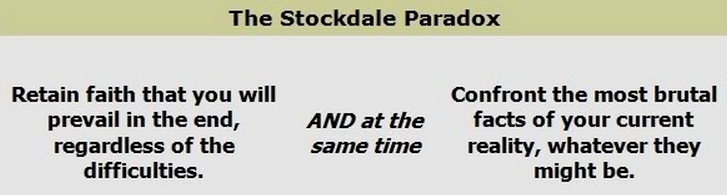
Widrich applies the Stockdale Paradox by arguing that businesses should abandon the mirage of silver bullets, the false hope that “just one more thing, tweak, etc., is going to turn everything around.” Instead, they should work hard, keep faith in their product, and persevere to see gradual growth and success.

But we can apply this principle to our spiritual lives and ministries too. Many Christians and churches seem to entertain unending optimism in “the next big thing” to make the “big breakthrough” in their lives and churches. The consequences are increasing numbers of disillusioned Christians and churches, some of whom are dying from broken hearts.

If we want to avoid this, let’s abandon all optimism that the next big thing, ministry, personality, sermon, technique, film, strategy, etc., will fix us or the church. Such “silver bullets” distract us from reality and have a habit of blowing up in our faces.

Instead let’s confront the brutal reality of our lives, our families, our churches, and our society. But, at the same time, let’s also keep steady faith in the Word of God, especially its sure promises of personal perseverance and the ultimate triumph of faith and of the Church of Christ.

Optimism is not faith. But faith is optimistic.


Check out

7 Reflections on an adoption that wasn’t meant to be
Deeply moving post from Justin Taylor. See and admire the gold of God’s work shining brightly in this dear brother’s life.

The Boston Bombers were outside their house
Interview with Stephen and Emily McAlpin, a Christian couple whose home was caught in the crossfire of 200 rounds last Thursday night.

Keeping our eyes on Christ
Robert Rothwell turns to Hebrews 12 to help him in the fight against distraction.

Discussing & Dealing with Pornography
Four helpful takeaways from Anthony Carter’s discipling of a generation who have been harmed by exposure to porn.

A brief lesson in letter-writing
How do you get people to pick up the phone to enquire is they are eligible for a refund? “Say what you mean; be brief; ask for action; follow up if you hear nothing.” Something for preachers here too?

What can we do to reduce the risk of suicide?
Sound advice from Adrian Warnock. And Hope for the suicidal mind from Paul Tautges.


Children’s Bible Reading Plan

This week’s morning and evening reading plan in Word and pdf.

This week’s single reading plan for morning or evening in Word and pdf.

If you want to start at the beginning, this is the first year of the children’s Morning and Evening Bible reading plan in Word and pdf.

Jason Henry, a missionary in Mongolia, has very kindly collated and produced the second year of morning and evening readings in Word and pdf.

And here’s the first 12 months of the Morning or Evening Bible reading plan in Word and pdf.

Here’s an explanation of the plan.

And here are the daily Bible Studies gathered into individual Bible books. Further explanation of that here.

Old Testament

New Testament

May God bless you and your children as you study the Word of life.


A Modern Parable of the Talents [Video]

(Email and RSS readers may have to click here to watch video)

I love what Rick DeVos is doing at Start Garden in Grand Rapids. Basically Rick has put together a $15 million dollar fund that invests $5,000 in two business ideas every week. One is chosen by Start Garden and the other is the one with the most endorsements from the general public.

Each $5,000 idea has about two months to do something constructive with the investment. Then they return to give an update at a public event, where a decision is made about whether to invest a further $20,000 in the business. If that goes well, then further investments of up to $100,000 are possible! And all this comes with advice and guidance from experienced business leaders.

A friend of mine has managed to get to the second stage with his G-RAPS idea. This would never have made it to market without Rik’s investment and encouragement. Wouldn’t it be great to see more wealthy business leaders not just multiplying their own “talents,” but helping others to do the same (Matthew 25:14-30).


Check out

How Mollie Hemingway introduced the nation to Kermit Gosnell
Trevin Wax traces the amazing impact of one Christian journalist in calling national interest to a story most mainstream media outlets were trying to ignore.

Mental illness and the church
There may be a few phrases that could be tweaked in this article, but it’s good to see such an influential website dealing so carefully with this issue.

Belief in angry God associated with poor mental health
With the usual qualifier of “this does not explain every case of mental illness.” (HT: Joel Miller)

Cultivate Gospel Conversations by Listening
A much neglected area of Christian discipleship.

Babies and Bathtubs (2)
My wife, Shona, continues her humorous series on being pregnant in America. Today she look at some of the “trendy questions” she’s been asked.

Why pastors quit
Jason tries to slow the quit rate with some biblical encouragements.


Education and the Digital Revolution

All schools and colleges are wrestling with the impact of the digital revolution on both the delivery of education and on the learning styles of our students. Online education is growing at 19% per  year, online enrollment now represents 25% of all higher education enrollments, and demand for online courses is now greater than demand for corresponding face-to-face courses.

As the dust settles (I hope) we are faced with four main options for delivering education:

1. The Traditional Lecture: Mainly a monologue where information is delivered orally from one teacher to many students at a set time each week.

2. Distance/Online Learning: Individual students are given the course materials and assignments to work through on their own and at their own pace. Usually a solitary learning experience, with little student/teacher interaction and no student/student interaction. High dropout rate.

3. Flipped Classroom: Instead of lectures in the class and assignments at home, the class is “flipped” so that students watch/listen to the lecture at home in their own time, and come to class to work though problems, assignments, application of lessons together with the teacher and other students.

4. Blended Learning: This tries to combine the best of the previous three methods. Most (though not all) lectures are delivered online. Classroom time is given to working on assignments, testing learning, applying knowledge, discussion, and also to special lectures. In addition, technology is used to facilitate collaborative (student-to-student) learning via forums, etc.

Here’s a paper with a synopsis of some of the most significant online articles that have been written on the evolving educational scene over the past year or so. The research is increasingly showing that the Blended Learning model is the way of the future for many (though not all) subjects. The advantages, in summary, are:

Advantages

  1. It costs the school less (30-50% less) and should therefore either reduce student costs or increase educational value.
  2. Reduced tuition increases accessibility of education to poorer individuals and communities.
  3. It saves time because the video lessons are prepared once and used (with some updating) thereafter. It also saves the student time because he/she does not need to be travelling to/from so many lectures.
  4. Research shows that students tend to complete the courses faster.
  5. The learning outcomes are equal to or better than traditional lectures.
  6. Class time used for practical application of knowledge.
  7. Emphasis not just on what you know, but can you use what you know. Not just the transmission/reception of information or ideas, but how to use them.
  8. More time for one-to-one mentoring, modeling, relationship building.
  9. Moves away from seat-time (credit hours) to competency.
  10. Tends to produce more creative and accurate assessment methods than traditional major paper plus end-of-semester exam.
  11. Plays to strengths of digital generation and provides means for constant student interaction and student-to-student teaching/learning.
  12. Reduces the need for new buildings.
  13. Increases personalization of education, customizing courses to individual learning styles, speeds, and needs.

Questions

  • What do you think of these trends?
  • Should seminaries just stick with the traditional methods?
  • What’s your experience of these different methods?
  • What are the best ways to make blended courses work?
  • Are there any subjects that should always be taught by traditional lecture?
  • Should schools offer different methods to suit different kinds of learners?
  • What should be a professor’s role? Do we need professors dedicated to online teaching?