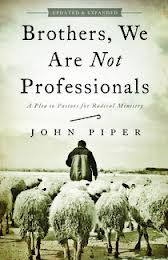
Brothers, We Are Not Professionals [Book Review]

Review of some chapters in Brothers, We Are Not Professionals by John Piper.
“Some chapters” because I am only going to refer to the six new chapters in this expanded second edition. Plenty of other reviews have been written about the material in the original book.

Most honest new chapter: Brothers, God does make much of us (4)
When great men (or women) realize they’ve taken a wrong turn, under- or over-emphasized some truth, or become imbalanced through trying to correct imbalance, they correct course and put things right – publicly.

Sadly that’s extremely rare. Some may correct things privately, but never say what needs to be said publicly. Others just stubbornly and proudly continue to teach the same things in the same way, no matter how much evidence to the contrary is presented. Still others dig even deeper to prove their theological muscles and macho spirituality.

Thankfully John Piper has the spiritual guts and the humility to sometimes say, “Hey, I went too far there,” or “I missed something out there.” That’s what he’s doing in chapter 4, which he calls a “mid-course corrective.”

It’s not that he taught major heresy or anything like that; just that he probably over-reacted to a particular evangelical problem, and now, with the benefit of time and thought, he is re-balancing to a more biblical weighting.

Most God-centered new chapter: Brothers, God is the Gospel (6)
Piper is concerned that we do not define the Gospel by its benefits alone. He wants us to go on past all the glorious benefits to see the glory of God in the face of Jesus Christ. That alone makes the other good things promised in the Gospel good. God is the Gospel because it brings us to Him. If it doesn’t, it’s not the Gospel.

Most courageous new chapter: Brothers, be Bible-oriented – not Entertainment oriented preachers (13)
Here Piper bravely takes on the flippant, funny, feel-good entertainment-type preaching that can be found in so many churches. He says the main problem with this “is that it is out of sync with the subject matter of the Bible, and diminishes our people’s capacities to discern and feel the weight of glorious truth.”

Most original chapter: Brothers, pursue the tone of the text (18)
For me, this was the most thought-provoking chapter, mainly because of my interest in preaching and in teaching students how to preach. Piper asks, “What tone should you aim at in preaching?” and answers, “Pursue the tone of the text.” I’m sure most preachers do this sub-consciously to some degree, but I found the ten areas of reflection in this chapter to be extremely helpful for stimulating a more conscious and intentional exegesis and communication of each text’s tone.

Most controversial chapter: Brothers, help them act the miracle (22)
These statements shouldn’t be controversial:

  • The cross of Christ unleashes power that expresses itself though my volitional attack on sin.
  • The cross becomes effective in conquering sin by empowering my will to oppose sin in my life.
  • The link between the cross and my conquered sin is a Holy Spirit-empowered will.
  • God intends that part of our experience of sanctification be the conscious, willed, opposition to specific sins in our lives.

That these statements are now controversial, indicates how confused the present church scene is. I’m hopeful that the clarity, balance, and exegetical accuracy of this chapter will go a long way to advancing the truth and impeding error.

Most practical new chapter: Brothers, bodily training is of some value (27)
A few years ago, I had to learn this chapter the hard way – through various operations and a brush with death. I hope the biblical balance and common sense of this chapter will prevent other pastors suffering similarly and also enable us all to see how God uses bodily health and fitness to open our eyes to His glory and serve Him better.

Concluding question: If you bought the original book, do these six additional chapters make the second edition worth purchasing?

My answer: YES!

Brothers, we are not professionals by John Piper (307 pages). Available at Amazon.com


Check out

31 Days with Samuel Rutherford
If you’re going to spend a dollar today, you won’t do better than this.

Raising the Dread
R.C. Sproul Jr., sorrowful yet always rejoicing.

Delivery Dynamics: Are you you?
Peter Mead’s been running a good series on the mechanics of sermon delivery (see previous posts here, here, and here)

Who has clean hands and a pure heart?
Appetizing taster from Anthony Carter’s new book , Blood Work, published by Reformation Trust.

Michael Jordan’s Greatest Season
Seth Getz: “Sometimes we look at someone who is successful and declare that they are “a winner” but what we don’t always see is the often long string of losing in that persons background.”

Revisiting the iron cage
Barry York replies to a letter from a young man who fears he has committed the unpardonable sin.


Children’s Bible Reading Plan

This week’s morning and evening reading plan in Word and pdf.

This week’s single reading plan for morning or evening in Word and pdf.

If you want to start at the beginning, this is the first year of the children’s Morning and Evening Bible reading plan in Word and pdf.

I was contacted this week by Jason Henry, a missionary in Mongolia, who had very kindly collated and produced the second year of morning and evening readings in Word and pdf. Thanks so much Jason, and may God bless you and your family as you witness to God’s truth in that needy land.

And here’s the first 12 months of the Morning or Evening Bible reading plan in Word and pdf.

Here’s an explanation of the plan.

And here are the daily Bible Studies gathered into individual Bible books. Further explanation of that here.

Old Testament

New Testament

May God bless you and your children as you study the Word of life.


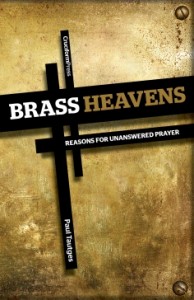
Brass Heavens [Book Review]

Book review of Brass Heavens by Paul Tautges

Unanswered prayer. One of the greatest challenges in the Christian life. We pray and pray and pray. Nothing. Why? If God hears my prayers and can answer my prayers, why doesn’t He do it?

Paul begins with a beautiful chapter on the role of each person of the Trinity in prayer, such an essential and encouraging foundation before taking on the BIG question of why this same God sometimes chooses not to answer our prayers.

He then lists six reasons in six chapters for why God does this:

  1. Pet Sins: The Care and Feeding of Rebellion
  2. Neglected Duties: When Conflicts and Offenses Go Unresolved
  3. Religious Sins: The Trap of Self-Worth
  4. Inconsiderate Husbands: A Man’s Failure to Understand and Honor His Wife
  5. Stubborn Pride: The Insistence on Going it Alone
  6. Testing our Faith: God’s Loving Incentives to Spiritual Growth

I found each of these chapters both convicted me and encouraged me. I’d rather know where I was going wrong, even though painful to admit, because at least then I can identify what I’ve got to put right. Sometimes we tend to think that God’s silence has nothing to do with us – leaving us completely at a loss, passive, fatalistic, and despairing. It’s often not so mysterious and inexplicable, says Paul, as he calls us to put right what’s wrong and enjoy new boldness in prayer.

As four of Paul’s ten children have impaired hearing, some of them having had cochlear implants, we are reading about a father who knows all about hearing difficulties! Paul’s connection with the struggles of everyday life is apparent in the illustrations that pepper the book and will encourage you that this is a man who is writing from the furnace, not the classroom.

Every Christian will need this book at some point in their lives. Read it to revive your prayers, to melt the heavens, and to increase answers.

Brass Heavens by Paul Tautges (118 pages). Buy at Cruciform Press or Amazon.


Check out

Matthew Parris goes to Africa, and “gets” religion (sort of)
I used to read Parris every week in the London Times and agree with Thabiti, he’s the most honest (and bravest) atheist I’ve read too.

How to have communion with the Spirit
J. D. Grear encourages us to press on to fellowship with God.

People you’ve probably never heard of but should
One of the first books I read as a young Christian was The Life and Labors of Asahel Nettleton, and it still impacts me 20+ years later.

What does cooking meals have to do with sermons
Looks like cooks and preachers have a lot to teach one another.

Hearts Atwitter
Just because your husband or wife didn’t get swept away with overpriced chocolates, teddies, and flowers yesterday, doesn’t mean he/she doesn;t love you.

The danger of do-it-yourself spirituality
Joel Miller: “A full and well-rounded spirituality cannot be a self-directed spirituality. Despite how it might look, such a pursuit will be almost definitionally narrow and fraught with delusion, not enlightenment.”


13 Reasons why Election is not Foreseen Faith

Is it that important to believe in unconditional election – God’s sovereign pre-creation choice to save specific people, irrespective of anything they would do or be? Can’t we just agree with other Christians who say that election simply means that God foresaw which people would believe and therefore chose them?

In his chapter on Unconditional Election, in Whomever He Wills, Andrew Davis lists 13 damaging consequences that follow from understanding election as merely foreseen faith (pages 58-74).

The Damaging Consequences

  1. It robs God of His glory as sovereign King of the universe: If God is the responder and man the initiator, God has surrendered control of the universe to the creature. God is a student of the human heart rather than the potter shaping the clay.
  2. Gives man ground for boasting: If our faith is the fundamental cause of our election before the foundation of the world, we can stand on our faith and boast.
  3. Severs the Scriptural connection between grace and faith: The Bible consistently presents faith as a gift of God’s grace, not the cause of it.
  4. Reverses the fundamental order of cause and effect: If our election is based on foreseen faith, that makes faith the cause and our election the effect.
  5. Is nowhere attested in Scripture
  6. Fails to understand foreknowledge properly: Foreknowledge means that God foreknows people, which is far more than knowing about people, and that “knowledge” is in the deepest sense a covenantal or marital knowledge.
  7. Contradicts Scripture’s testimony that election is the ground of faith: It is because of divine election that all true Christians believe.
  8. Finds good in man apart from sovereign regeneration: If the Bible describes us as “dead in trespasses and sins,” what good did God see in unregenerate people when he looked down through the corridors of time?
  9. Reverses who elects whom: The Arminian view makes God’s election of us follow our election of God logically.
  10. Makes the ultimate difference between someone in heaven and someone in hell something in man and not something in God: What makes the difference between a person who ends up in heaven and someone who ends up in hell? Something in the human heart or something in God’s heart?
  11. Makes God’s election a matter of justice, compulsion, and reward, not sovereign freedom: In the Arminian view, whenever God identifies this independent, man-originated faith, God is compelled by something outside Himself to elect that person to eternal life.
  12. Strips people of true freedom of choice: The doctrine of election based on foreseen faith makes both God and man subservient to another “force” or “drive” in the universe which neither can ultimately control.
  13. Renders evangelistic prayer meaningless: If God cannot or will not interfere in the inner workings of the human heart to bring about faith, what exactly are we asking Him to do when we pray for a lost person?

The Blessed Benefits

Andrew then proceeds to list four benefits of unconditional election (pages 75-76):

  1. God gets the full glory for human salvation: Unconditional election means that God deserves full praise and glory for every aspect of human salvation.
  2. The human heart is humbled: There was nothing in us whatsoever that moved God to choose us.
  3. Security: Our salvation is completely secure because it was neither initiated nor sustained by us.
  4. God-centered confidence in evangelistic and missionary endeavors: An evangelist or missionary that goes forth in the name of sovereign grace can do so with a completely humble confidence in God that the mission will be successful under God’s eternal purposes.

This is a superb chapter and should help to remove any grounds for apology or embarrassment for believing or teaching this doctrine.

But before you go out and use this as a club to beat up your Arminian friends, let’s also remember especially the first part of the Westminster Confession’s conclusion about the doctrine of election:

The doctrine of this high mystery of predestination is to be handled with special prudence and care, that men attending to the will of God revealed in his Word, and yielding obedience thereunto, may, from the certainty of their effectual vocation, be assured of their eternal election. So shall this doctrine afford matter of praise, reverence, and admiration of God; and of humility, diligence, and abundant consolation to all that sincerely obey the gospel (WCF 3.8).