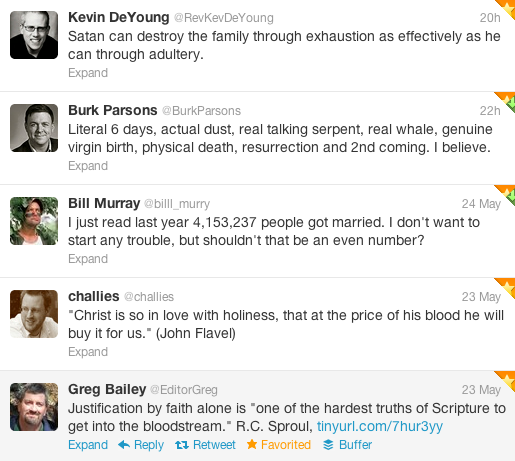
More Tweetables here.
More Tweetables here.
“The sandwich method” is the correction strategy that puts every criticism between two slices of praise. According to Sam Crabtree, an expert on how to praise people, it’s not a tasty snack.

In Practicing Affirmation, Sam describes the manager who used the sandwich method so much, that employees began to dread hearing any praise because they knew what he was about to fill the sandwich with. Although he boasted about his method, his employees eventually called it “the baloney sandwich!”
Sam says, “Let affirmation stand alone, separated from correction….correction packaged with affirmation will contaminate and weaken the affirmation, perhaps making it altogether fruitless…Corrections tend to cancel affirmations, and the closer the proximity to correction, the more crippled the affirmation” (63, 64, 65).
It’s that close proximity of correction to affirmation that Sam argues against. In its place he proposes a much longer-term context of loving affirmation as the necessary backdrop to any loving correction.
It’s love that earns “a platform from which to challenge wrongful lifestyles and to be heard in doing so.” He says this many different ways, but in some ways it cannot be said enough. Our corrections will have no effect if there is no deep, wide, and long context of encouragement and affirmation: ”People are influenced by those who praise them. Giving praise does wonders for the other person’s sense of hearing” (54).
Also, as corrections tend to “weigh” more than affirmations, he suggests an affirmation to correction ration of at least 3:1, and preferably closer to 5:1. He illustrates:
Affirmation and correction are like a bank account. Affirmations are deposits. Corrections are checks you write against the balance in your account. If you write too many checks in relation to the deposits, your checks bounce – they’re no good. It will take additional credits to restore your your credit. And if the pattern of writing bad checks continues…your account may be frozen until you get serious about putting things in the black (52).
Sam doesn’t really want us going around with ledgers though: “Relationships are healthy when so much affirmation is being spread around that no one is keeping track of either affirmation or correction” (54).
For a book on how to praise people, Sam’s book is also remarkably helpful on how to correct and criticize in a constructive way. I’ve just highlighted a couple of the bigger principles, but he goes into a lot more detail in the book.
Practicing Affirmation Review (1): Scots don’t do praise
Practicing Affirmation Review (2): 10 ways to praise people
Practicing Affirmation Review (3): Is the “sandwich method” a lot of baloney?
Practicing Affirmation Review (4): Should we praise unbelievers?
Infographic of the Kings
If you thought British history was complicated, wait until you try to figure out the Kings of Israel and Judah. The Good Book blog helps us all out with an infographic that displays the chronological order together with a simple color key to their moral quality.
Laid-back homeschooling
Janie takes us on a trip down memory lane to the pre-Abeka and pre-Bob Jones days.
Raucous joy
Bob takes us to an elementary school talent contest: “As I was enjoying life with them, I was struck by the fact that sometimes Christians—who have the most reasons to enjoy life—enjoy it the least. If you were to assess the level of life enjoyment by the state of the Evangelical Christian blogosphere, for example, you might find little joy. Blog after blog we emphasize what we are against. Blog after blog we highlight how other Christians are wrong.” Totally with you on this one, Bob!
10 Tips for New Church Planters
I’d add an 11th: Take weekly Sabbath.
Leadership Core: Education and Experience
“Beyond your personality, talents, and spiritual gifts, your capacity to contribute is bolstered by what you choose to add to your leadership core through the “double e’s” of experience and education. Education and experience enhance who you are and strengthen your strengths.”
Gospel-Centered Bible Study (free eBook)
Dave Moser (Armchair Theologian) has put together a short, punchy book on how to study the Bible in a Christ-centered way.
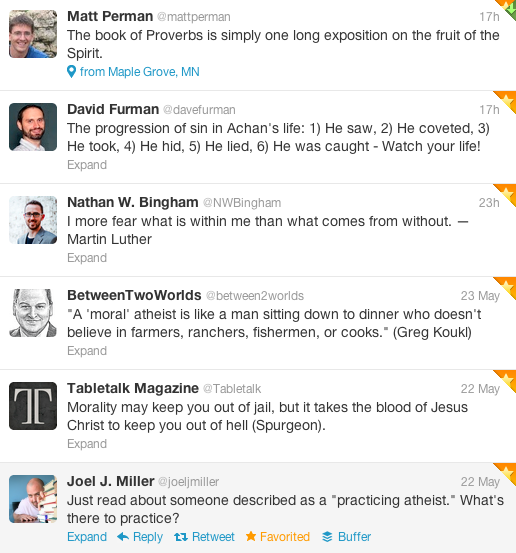
More Tweetables here.
As someone who has recently passed through the long and sometimes painful process of finding a literary agent, submitting a book proposal to numerous publishers, and then negotiating a book contract, I know how important the word “platform” is.
Although I’d previously associated it only with trains on my daily commute to work in Glasgow, I now know that it’s probably the number one thing that most publishers are looking for. You can have the greatest idea or epic story, and you can write like C S Lewis or J K Rowling, but without a platform you’re not getting near the bookshelves, I’m afraid.
A platform is basically what we stand on to raise us above ground level. It’s what lifts us a bit higher than our surroundings. In the publishing or business context, it’s whatever gets our writing or product noticed or stand out from the crowd.
In the “olde world” a platform was built out of marketing and advertising, newspaper ads, TV and radio commercials, brochures and leaflets, etc. In the new digital world it’s built out of Blogs, Tweets, Status updates, Likes, Youtube, podcasts, etc.
Good and bad news
And that’s good news and bad news. The good news is that building a platform today is much cheaper and much more accessible. We can all do it; in fact, we are all doing it; the only question is how consciously, thoughtfully, and deliberately we are doing it. The bad news is that it’s so time-consuming, so difficult to do well, and so spiritually hazardous.
And that’s where Michael Hyatt comes in. Michael has been involved in publishing for many years and is presently Chairman of Thomas Nelson. I’ve learned so much from reading his lively blog over the past couple of years. He has great insights on leadership, writing, and publishing – his Writing a winning book proposal was a godsend to me.
Social Media Pioneer
But it’s in the vast and challenging area of social media that Michael really excels. As one of the world’s social media pioneers, he has huge experience and expertise to share. And if Michael’s anything, he’s one of the world’s sharers. That’s probably why he’s been so successful in social media; because the willingness to share value, to involve, engage, benefit, and bless others is the DNA of any edifying and effective social media strategy.
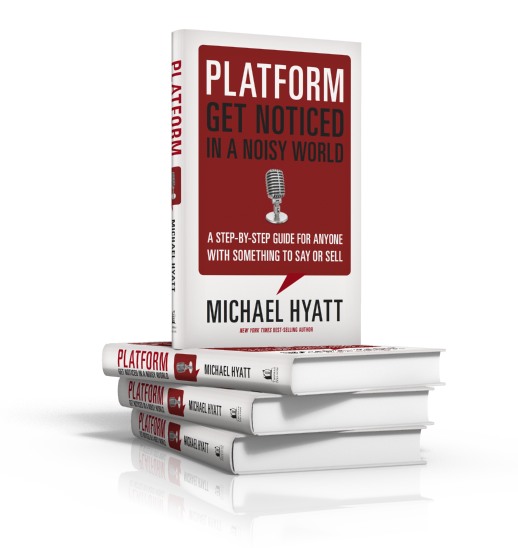
Well, you’ll be glad to know that Michael’s impulse to share has led him to publish a book on this subject. It’s called Platform: Get Noticed in a Noisy World. He describes it as “A step-by-step guide for anyone with something to say or sell.” And if you buy before May 25 you can get $375 worth of bonus material.
Blook?
I finished the book last night while waiting in the forest for Thanksgiving Dinner (they didn’t oblige, but we’ll be back tonight!), and appropriately enough it was the first book I’ve read entirely on my iPhone! The format of the book really helped that because it’s split into five main sections with numerous blog-length chapters in each section, all of them characterized by compact, practical, lively writing, and most of them presented in list/bullet format.
And whether we like it or not, I think Michael’s ahead of the curve here again in his employment of blog-style writing in book form (a blook?). It definitely works. And I learned a lot, or at least realized how much I have to learn, because this is a book I’ll be coming back to again and again.
Spiritually hazardous
But let me briefly return to the “spiritually hazardous” nature of social media and platform building. Probably most Christians, especially those in ministry, wish that this subject would go away. The idea of building a platform seems, on the face of it, so antithetical to the essence of Christianity. How can we possibly square this with personal humility, meekness, self-denial, and John-Baptist-like “He must increase, I must decrease” etc? Although Michael touches on this, its a question I’d like to see him tackle at greater length, perhaps on his blog or on his podcast.
There must be some specifically Christian guidelines for this, some way that Christians can be refreshingly different from the world. For those in ministry, maybe it all comes down to who’s really on the platform. Is it me? Or is it Christ? Am I building up myself? Or am I building a platform for Jesus?
How God can use your anxiety for good
Laura Turner appeals for less Bible quotations and more understanding.
Effective Bible Teaching: Geography
Understanding biblical geography can save you a lot of embarrassment.
The Difference between Normal Postpartum Stress and Postpartum Depression
Helpful checklist for young mothers and for pastors.
The fruit of the Spirit and your work
Loved this down-to-earth spirituality post from Matt Perman: “”When we are doing our work, we aren’t just doing work. We are engaging in an opportunity to display the fruit of the Spirit and manifest the character of God all day long, right here in the concrete realities of everyday life.”
40 lessons I’ve learned after preaching my 400th sermon
Some funny, some painful, most insightful.
Tabletalk on Logos
256 searchable issues for $300.