Pastors and Social Media (1): Be Positive

Last week I had the privilege of addressing the URC Pastor’s Conference on “Blogs, Facebook, and the Flock: What is the relationship between social media and the local pastorate?” Here’s the first part of that address.

“If the leader is not leading in the digital world, his leadership is, by definition, limited to those who also ignore or neglect that world, and that population is shrinking every minute. The clock is ticking…, if you are not present on the Internet, you simply do not exist, as far as anyone under 30 is concerned.” So writes Al Mohler, confirming the importance of social media for pastors.

Social media and the local pastorate
“Social media” means I’m not speaking about church websites, which are generally static shop windows without the social, interactive, relational component of social media.

“Local pastorate” also limits the subject. My task is to provide guidance for local pastors especially as they interact with their local church and local community. Although God may open a much wider door of usefulness via blogs, etc., it’s important that local pastors do not aim for that and, even when given such opportunity, do not make that wider audience the priority at the expense of ministering to their own flock.

Take a positive approach

Don’t be a digital dooms-dayer. Yes we must be aware of the dangers in social media, and, as pastors, we must alert and protect our sheep. But if we only or largely communicate condemnation and warning about social media, etc., then most people, especially young people, will just turn off. As Al Mohler said:

The digital world did not exist a generation ago, and now it is a fundamental fact of life. The world spawned by the personal computer, the Internet, social media, and the smart phone now constitutes the greatest arena of public discussion and debate the world has ever known.

“It’s a fundamental fact of life.” That means, if you want to be where people are, then you need to be in social media. But it shouldn’t be done holding your nose and wishing you were alive 100 years ago. Consider some of the spiritual benefits of social media.

Evangelism Benefits
The opportunities to connect and communicate there for the advance and benefit of the Gospel are unparalleled. Social media is carrying the Gospel into China and North Korea, into schools and universities, into the public square and our local communities.

Personal Benefits
There are personal benefits too, as I recently highlighted in How technology made me a better Christian. The digital revolution has increased our theological knowledge, our cultural engagement, our ministry reach, our evangelism, our apologetics, and our love for one another.

Community Benefits
Social media is often blamed for undermining social contact. However, for many people, social media has helped build community, especially for people who are perhaps more timid and nervous, or socially isolated. In The Blessings of the New Media, Ed Stetzer:

I do not believe that virtual community and real community are enemies. I see them more as friends, the former as a help to the latter….While social media cannot replace real-life interpersonal relationships, they can assist in building real community by connecting people in ways that allow them to share both the big and small things of life. Web services such as Facebook allow people who might see one another only during church on Sunday, or midweek in smaller community groups, to continue to share aspects of life they would not otherwise. This allows friends to look into the parts of life we share and respond with encouragement or exhortation.

Heart Problems
Although  social media has undoubtedly been used of the devil to damage souls, it’s important to remember that the problem is not so much social media but our hearts (Matthew 15:17-19). Technology journalist and social media addict, Paul Miller, was recently paid by Verge  magazine to spend a year offline. Initially he found that many of his bad habits were suddenly broken. However, by the end of the year, he said:

I’d learned how to make a new style of wrong choices off the internet. I abandoned my positive offline habits, and discovered new offline vices. Instead of taking boredom and lack of stimulation and turning them into learning and creativity, I turned toward passive consumption and social retreat…

A year in, I don’t ride my bike so much. My frisbee gathers dust. Most weeks I don’t go out with people even once. My favorite place is the couch. I prop my feet up on the coffee table, play a video game, and listen to an audiobook….

Make a positive contribution

So, I’m saying take a positive approach to social media. But also, make a positive contribution. The average person complains 15-30 times per day, with a ratio of 1 to 6 in terms  of encouragement to criticism. Research has demonstrated that the ideal positive to negative ratio in a relationship, in a church, or on a team is 6 to 1, the reverse of most people’s experience! In The Digital Leader, social media guru, Erik Qualman, warns what will happen if our social media presence is largely critical or negative:

We don’t want a trail littered with complaints and negative comments…If you habitually complain you will either a) have your followers leave you since people like to follow individuals that inspire hope, or b) have a legion of chronic complainers. Neither of these resulting scenarios will benefit you and you will cease being an effective digital leader.

Therefore, make Philippians 4:8 the general banner of all your social media work.

Tomorrow we’ll look at the most important question you can ask when using social media.

Check out

Pastors need your care
Jason Helopoulos suggests a few ways members of the congregation can care for their pastors. And here he makes a few suggestions for how elders can intentionally care for their pastors.

When Christians fire Christians
Dr Thom Rainer says this is one of the questions he is most asked: “Should we as Christians fire other Christians who work in our organization?”

Mothering through depression and chronic illness
Luma Sims with a moving testimony to the Lord’s grace in tough times.

Pastoral Bullies
Sam Storms with 23 ways pastors might domineer their flocks. (HT: Matt Perman)

Ligonier welcome Dr. Steve Nichols as their new teaching fellow
I am full of admiration for the way Chris Larson and his Ligonier team are managing the transitional years for this important ministry. Steve Nichols is another great addition to the teaching team. And special credit must also go to Dr. Sproul for the humble way he is handing on the baton.

Hobby Lobby wins major victory
Let’s not ignore the good news, even when we’re in the midst of so much discouragement.


Children’s Bible Reading Plan

This week’s morning and evening reading plan in Word and pdf.

This week’s single reading plan for morning or evening in Word and pdf.

If you want to start at the beginning, this is the first year of the children’s Morning and Evening Bible reading plan in Word and pdf.

And here’s the second year of morning and evening readings in Word and pdf.

And here’s the first 12 months of the Morning or Evening Bible reading plan in Word and pdf.

Here’s an explanation of the plan.

And here are the daily Bible Studies gathered into individual Bible books. Further explanation of that here.

Old Testament

New Testament


The worst phone call of my life

“Bu-ring, bu-ring….Bu-ring, bu-ring…”

iPhone displays my son’s name: “Allan Murray”

9.45 pm.

I’m expecting the usual, “Dad, the Bible Study ran a bit late and we’ll be home at 10.15-ish.”

Instead.

“Eeeeeeeeeee-aaaaaaaaaw……Eeeeeeeeeee-aaaaaaaaaw”

An almost deafening siren. With multiple others in the background.

And heavy breathing. Pants. Gasps.

My wife analyzes my face. I try calm, controlled Dad expression.

More sirens. More grunts and groans.

Seconds slow down and pass slowly by.

“Allan! Allan!! Allan!!!” I give up on control and just resort to being Dad.

“Dad…”

Best word I’ve ever heard in my life.

“Dad…we’re both OK.”

Best four words I’ve ever heard.

I repeat them for Shona’s benefit.

“A drunk driver hit us…but we’re both OK.”

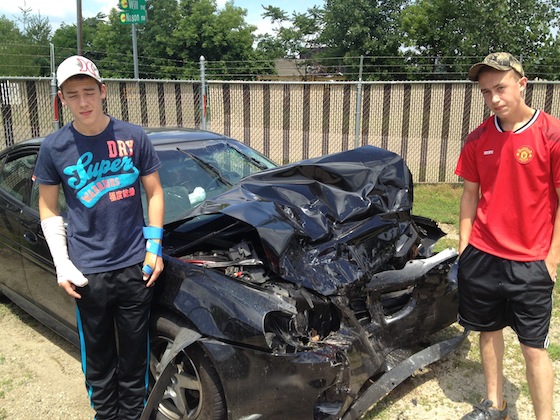
Within 30 minutes we meet up in the hospital. Allan’s on a board with a neckbrace and Angus is recovering from a bleeding nose, a pummeled face, and, strangely, two very painful thumbs. A few hours and a few CT scans later, we’re all home and reviewing what happened…again and again. 

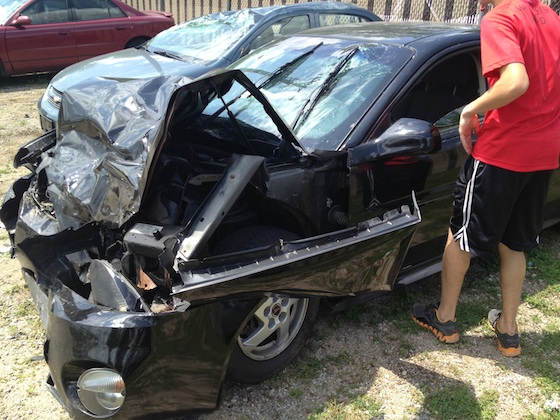
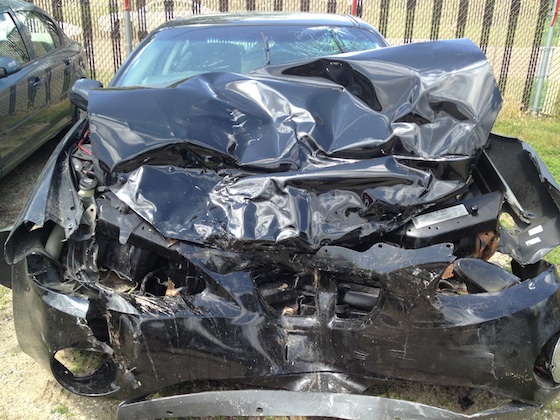
The Pontiac Grand Prix

The Collision
Allan, who’s seventeen, was driving my car along Lake Michigan Drive, doing about 45 mph, when a drunk driver (or under the influence of something) in a black Pontiac, coming from the opposite direction, suddenly turned in front of them. There was nothing Allan could do, apart from swerve slightly just before impact. All the air bags deployed. After a few seconds of disorientation and shock, they both stumbled out of the car as fast as they could because they could smell gas and liquid seemed to be everywhere. Allan fell over and was helped by a bunch of motorcyclists who witnessed the accident.

Ambulance, police, and fire-trucks were there within minutes and soon they were on their way to hospital. The emergency workers were fantastic, reassuring the boys that there were multiple witnesses who saw exactly what happened and that the other guy would be charged. That is, if he escaped the fury of the bikers, especially one female biker!

The Ford Escape

The Injuries
Allan has whiplash and chest abrasions. Angus has a sore face and two broken thumbs – he was texting when the airbag went off and pushed his thumbs backwards, with his phone, into his face. He’s now in a thumb cast and a thumb brace. Weird, eh?

The car is totalled, but who cares. They were spared serious injury and even death, and we praise God for His sparing mercies. We also pray that the Lord would bless this to their souls, increasing their spiritual urgency and seriousness. As Angus said, “For a few seconds, I couldn’t breathe, and I did wonder if I was alive or not.”

The Pontiac Grand Prix side view

The Mercies
Strangely, Shona and I had both separately read Psalm 121 that morning. Maybe that was because the day before, Tuesday, our family had been spared another potential tragedy. Last week, Allan bought an economical car to help him with his new business. It was a Ford Escape 2003 and he paid $2900 for it (all he had plus a little help from ourselves). Tuesday afternoon, he was leaving our driveway when the axle broke at the wheel joint. The car collapsed on one side and the wheel completely buckled. Not only were we thankful that Allan was not driving on the highway when it happened, but Shona had been driving it with our four other kids (including the baby) just two hours before. God is MERCIFUL!

That car also is totalled. It cannot be repaired for less than it’s worth. Although I tried to keep focussed on God’s mercy afterwards, I must confess it was still very painful to think that we’d just poured $2900 down the drain (we had got it checked by a mechanic before purchase).

However, today we are rejoicing that God broke the old Escape so that in their collision Allan and Angus were driving the 2010 Escape with all its modern safety standards and equipment. I think I counted at least six airbags that had deployed. As the salvage man said, “The car did its job well.”

$2900 for the lives of my sons? I’ll take that, thanks. A LOT.

On a slightly humorous note, our recently-purchased used tractor mower was also totalled this week! Transmission failure and again not worth repairing. I’m waiting to discover what disaster God is saving us from with that!

Two sobered sons.


Check out

Twenty Types of Tweet
Helpful, especially if you believe, as Leonard Sweet does, that Twitter is “the ultimate medium for discipleship!”  I think (hope) that’s slightly tongue-in-cheek, but Sweet goes on to explain “the four leading ways that Twitter has changed my life and made me a better follower of Jesus.”

Christ-centered Hermeneutics and Typology
Ed Stetzer is hosting a discussion about Christ-centered interpretation of the Old Testament. In the second installment of my own contribution, I argue that the most important question in Old Testament interpretation is, “How were Old testament believers saved?”

The “right side of history” is full of re-writes
Ted Olsen cautions supporters of gay marriage that “fortune tellers don’t have great track records.”

Please don’t say this to me
Voddie Baucham’s daughter pleads with parents to stop saying to her: “I just want you to tell me everything your parents did with you so that I know how I can have a daughter exactly like you.”

What is Christian literature?
Joel Miller’s answer: “God’s truth, wherever you find it.”

The Sad Christian
If you want to begin to understand what depression is like, this is where to start. This is so raw, so real, so honest, so well written. Thank you, Michael Patton, for articulating the feelings and thoughts of millions of our fellow-Christians.


7 Lessons for Christians from the “Gay Victory”

In Victory, a scholarly survey of “the triumphant gay revolution,” author Linda Hirshman analyzes “How a Despised Minority Pushed Back, Beat Death, Found Love, and Changed America for Everyone.” Although the book is a painful read for Christians, there are some strategic lessons that we can learn from this remarkably sudden cultural turnaround.

1. Aim high
Gay activists aimed much higher than black rights and women’s rights movements; not just tolerance, but approval of their difference; not separate but equal, but rather integrated and admired.

2. Moral certainty
Homosexuals have convinced themselves (and others) that they are not only moral, but that their morality is superior to Christian morality, and therefore should replace it. As Hirshman says: “It is the moral certainty of the gay revolution that explains why, unlike the racial and feminist movements, it has been able to stand up to that powerful counterforce [the morally driven religious right] and, slowly but surely, prevail.”

3. Identify primary enemies
Gay activists identified four major obstacles to achieving their strategic objective:

  • The churches considered them sinful
  • The state criminalized their sex acts
  • Doctors – mainly psychologists – thought they were crazy
  • The military feared they would be traitors to the nation.

The gay movement worked tirelessly and furiously to overcome these “four horsemen of the gay apocalypse” – Sinful, Criminal, Crazy, and Subversive.”  The accepted versions of sin, crime, sanity, and loyalty were mortal enemies that had to be taken down and replaced.

4. Unite on the essentials
One thing that comes across in the book is the powerful unity of the multiple diverse strands of the gay movement (although Hirshman admits that a lot of that powerful unity was based on the unifying power of sex – “It’s hard to take the sex out of homosexual.”)

5. Refuse to compromise
Despite many political and judicial victories over the years, the gay movement would not stop short of victory over the military and the church. Repeal of “Don’t ask, don’t tell,” was non-negotiable and achieved in 2011. And, as we’re seeing, no amount of “Civil Partnership” compromises will satisfy the demand for moral approval through marriage equality.

6. Never give up
Many thought that AIDS would be the end of the gay movement. However, in what is the most stunning claim in the whole book, Hirshman says, “AIDS was the making of the gay revolution.” The gay community leveraged this setback to secure massive funding not just for medical treatment, but also for educational and community initiatives.

7. Influence every strata of our culture
In a section that goes a long way to explaining why the legal culture is so anti-Christian, Hirshman points out that law firms have “become among the best places in America for gay and lesbian employees…The legal sector has the largest number of top-scoring companies in HRC’s Corporate Equality Index.”

And course, in addition to learning from these strategies, we have powerful resources that the gay community knows nothing of: prayer, the Bible, the Holy Spirit, and Christ-like loving and living.

For another perspective on how Christians should face the future, see Prepare for Gay Marriage.