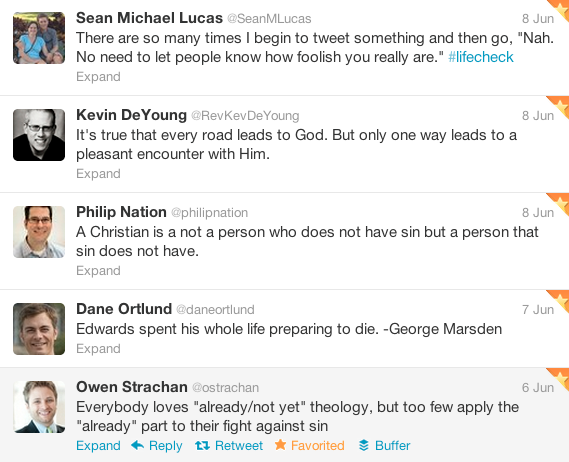
More Tweetables here.
More Tweetables here.
This week’s morning and evening reading plan in Word and pdf.
This week’s single reading plan for morning or evening in Word and pdf.
If you want to start at the beginning, this is the first 12 months of the children’s Morning and Evening Bible reading plan in Word and pdf.
And here’s the first 12 months of the Morning or Evening Bible reading plan in Word and pdf.
And here’s an explanation of the plan.
As it’s about this time of year that many small-group Bible studies begin thinking about new curricula for the Fall and Winter sessions, I’d like to heartily recommend Nancy Guthrie’s Seeing Jesus in the Old Testament series. Nancy has now written two of these 10-week Bible studies, the lastest of which is The Wisdom of God – Seeing Jesus in the Psalms & Wisdom Books. Let me give you seven reasons to consider these wonderful resources:
Although I take a different tack to Nancy on the Song of Solomon, both approaches end up at Christ. I hope many will experience the blessings of spiritual heartburn through these books (Luke 24:32).
Gospel-Centered Bible Study
Here’s a two part interview (Part 1 and Part 2) with Dave Moser, who has recently written a free eBook on Gospel-centered Bible Study. Great testimony about how a Catholic Mass and the Gospel Coalition Conference on Christ in the Old Testament changed Dave’s life and ministry.
Multi-ethnic Worship
Juan Sanchez writes a fascinating piece about his church’s wonderful attempts to unite different cultures in one worship service.
The Masculine Mandate for 99¢
This is perhaps the best book I’ve read on male leadership. Get it today for 99¢!
A quiet place, a quiet hour, a quiet heart
Tim takes us back to the basics of prayer. This will definitely help your spiritual life.
In praise of inefficiency
This is a hugely encouraging article on the neglected role of Christian parents as divinely-designated amateur disciple-makers.
Job the Film
This looks like a powerful presentation of the Gospel through a dramatic animation of the book of Job.
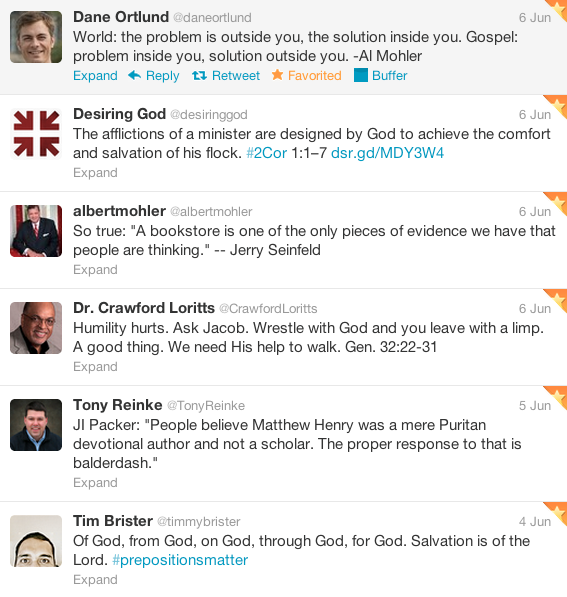
More Tweetables here.
Feeling sad? Don’t reach for your radio – unless it’s a “Golden Oldies” channel – because over the last 50 years pop hots have become longer, slower and sadder (summary here).

Researchers who listened to a sampling of 1000 Top 40 songs from the last 50 years and found that:
Over the years, popular recordings became longer in duration and the proportion of female artists increased…There was also an increase in the use of minor mode [which most associate with gloom and despair] and a decrease in average tempo, confirming that popular music became more sad-sounding over time. Decreases in tempo were also more pronounced for songs in major than in minor mode, highlighting a progressive increase of mixed emotional cues in popular music.
Notice the tentative connection of more sad songs with more female singers! Brave researchers (or foolish!). On a more “positive” note, the study says that Lady Gaga’s fast-tempo, major-mode recordings has risen above (below?) these trends.
Lady Gaga apart, I wonder how much this downward emotional trajectory is connected with another trend, reported last year, of popular music lyrics becoming more self-focused and negative?
The researchers found the use of first-person plural pronouns (we, us, our) declined over the years, while the use of first-person singular pronouns (I, me, mine) increased. Words reflecting anger or antisocial behavior (hate, kill, etc.) became more prevalent over the 28-year period.
Conversely, terms depicting social interactions (talking, sharing) became less common, as did the use of words conveying positive emotions (love, nice, sweet). These findings mirror “recent evidence showing increases in U.S. loneliness and psychopathology over time.”
We probably didn’t need psychologists to tell us that an increasingly self-focused and negative society is an increasingly sad society. But the data source is intriguing and surprisingly revealing.
But let’s turn the spotlight on ourselves. What about the lyrics and music of Christian praise? Is it counter-cultural or simply following modern trends? If someone was to research the lyrics and music of Christian songs over the last 50 years, what conclusions would they draw? On the rare occasions that I listen to CCM on the car radio, there seems to be a generalized ”whine” in most of the songs. How much of our message is being obscured or denied by our medium?
And fellow Psalm-singers, the inspired words that we sing are balanced towards the God-focused and the positive; but do our tunes and the way we sing them match our words? Or by getting sadder, slower, and longer does our medium confuse our message?